During the winter of 2026, I relistened to walking interviews I had conducted with feminist activists in 2021. I decided to revisit my undergraduate dissertation, adapting it to a non-specialist audience. All work is my own.
Dedicated to all the participants of this project, without whom this would not have been possible.
To the memory of the 119 victims of femicide in France in 2021.
To my college tutors for their advice and support, your teaching has been invaluable.
An introduction
It is sometime after midnight. Four figures dressed in black stand before a high wall on a deserted Paris street. In silence, one begins to brush along the wall with generous strokes of sticky, watery paste. Following the momentum of the brush, a second figure walks closely behind slapping single A4 sheets of paper — each sheet carries one large capital letter, bold and black. At the tail end of the ritual procession, a third figure splashes on more paste to fix the letters and its messages to the wall while the fourth figure, the look-out, stands aside to signal warning if needed… Slap, a final brush stroke, the job done, they pack to go while the sentinel hurriedly snaps a shot of their latest creation. And then they are gone.
It took three minutes. On the wall, a collage of letters reads:
FÉMINICIDES
ÉTAT PASSIF
TUEURS ACTIFS(Femicides, passive state, active murderers)
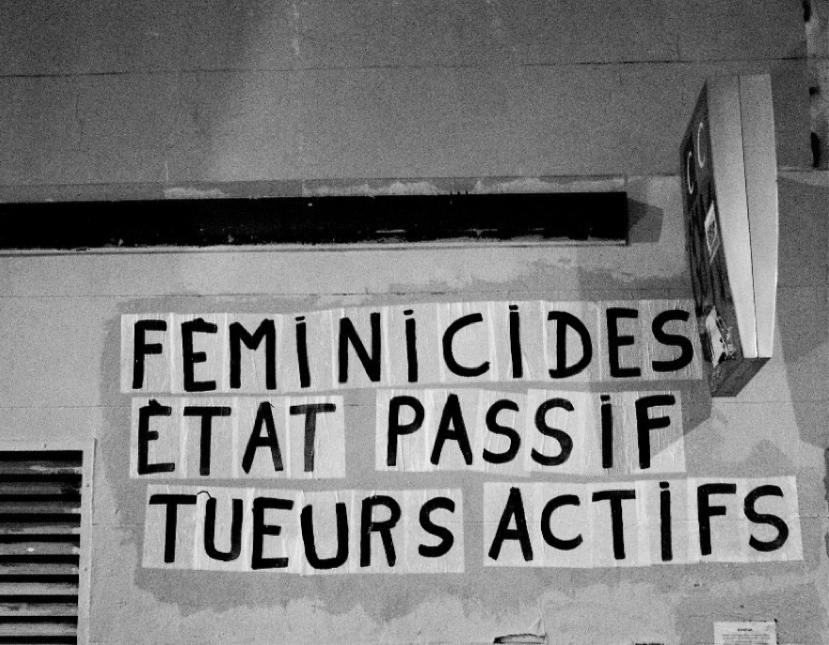
I first saw these slogans in late spring 2020. I do not know exactly which ones I had read at the time, but I remember being intrigued by this form of urban conversation that kept appearing, unexpectedly, across Paris.
What were they, and where had they come from?
First used as a way to raise public awareness about the issue of femicide, collages are slogans made up of A4 sheets of paper glued to walls. Their creation is the work of intersectional feminist collectives, known as “the colleur·euses”, a term that combines the masculine and feminine forms of the French word for ‘those who paste’.1
Though urban streetwise feminism had been extensively studied, the colleur·euses had received little academic attention from geographers, turning what had started as a personal obsession into the subject of my undergraduate dissertation at the University of Oxford, where I studied Geography.
I spent most of the summer of 2021 trying to get into contact with these hooded figures. Unbeknownst to me at the time, my original outreach message had been flagged by collectives across France. The collectives’ safety protocol advised against accepting unsolicited attention from external parties to protect the safety and anonymity of their members. Some of the participants said that others had asked them to vet my trustworthiness before expressing interest; others turned down my invitation altogether, out of caution rather than disinterest. Despite this, 33 individuals across 15 locations agreed to meet me for a walking interview, which seemed a natural method of data collection, given that the colleur·euses walk around their neighbourhoods to paste.
I went back to Oxford in October and spent weeks transcribing and analysing interviews conducted in French, before submitting the dissertation in January 2022. Almost four years later, after having worked in a corporate job ever since I graduated, I listened to all these recordings again, and decided the stories deserved a wider audience.
What does it mean to claim a city at midnight, in spaces that have quietly been ceded to men? Whose names survive on its walls? And, who, exactly, gets to paste, when the practice that presents itself as open to everyone turns out to demand more than paint and paper?
What is a collage: the origins and mechanics of the movement
In France in 2019, a woman was killed every two and a half days as a result of femicide, according to Nous Toutes. It was against this backdrop that Marguerite Stern pasted the first collage in Marseille:
“DEPUIS QUE J’AI 13 ANS LES HOMMES COMMENTENT MON APPARENCE DANS LA RUE”
(Men have been commenting on my appearance in the street since I was 13)
Photographing the freshly glued message immediately became an integral part of the process: partly for archival purposes, since collages rarely survive long, and partly because Instagram has become an extension of the wall itself. By the summer, collectives had formed in Paris, and as images of collages circulated on Instagram, activists in other cities and countries began organising their own sessions.
Yet, the movement’s relationship with its own founder did not survive its growth. In early 2020, Stern released a series of transphobic statements on Twitter, and the collectives severed ties. Beyond a simple rejection of Stern, the movement made political clarifications, cementing the explicit exclusion of trans-exclusionary radical feminists (TERFs) as a founding principle, alongside the commitment to mixité choisie — spaces deliberately and unapologetically closed to cis men.
Kimberley Crenshaw coined the term ‘intersectionality’ in 1989 to describe how systems of oppression — race, gender, class, disability, sexuality — do not operate in isolation but overlap, producing distinct and compounded experiences of discrimination. While violence against women and gender minorities remains the movement’s primary focus, the walls also speak against racism, fat-phobia, LGBTQIA+phobia, whorephobia, ableism, ageism, and classism.2
This leitmotiv unites collectives across the country. Julie (all participants mentioned hereafter have been given a randomly allocated pseudonym), from a collective in Angers, described the one time her group made an exception by accepting three cis men who reached out to paste against the closure of theatres during the pandemic:
“We quickly regretted it. The men kept telling us what to do and where to paste. Funnily enough it’s actually the only time we got caught.”
The exception proves the rule.
Though collages remain a relatively novel form of action, women have turned walls into contested surfaces for generations in France. In 1792, Olympe de Gouges subverted the placard — posters traditionally used to disseminate official State statements. Claiming a surface that was not intended for her, she repurposed the medium for political expression, notably to voice her opposition to the execution of Louis XVI after the French Revolution. According to historian Christiane Bard, it was not until L’Union des Femmes during the Paris Commune that feminist movements returned to the poster in a sustained way. In 1934, journalist and suffragette Louise Weiss deployed red capital letters on a white background to campaign for women’s right to vote: “La Française doit voter” (the Frenchwoman must vote). Later on, la Maternité Heureuse, founded in 1956 and later renamed Le Planning Familial, used posters to demand the right to contraception and abortion, while the Mouvement de Libération des Femmes carried them through the streets in May 1968.3
While feminist posters in the past were often centred around a visual representation, collages are only made up of hand-painted letters on paper, focusing on the essence of the message instead. The decision about which words go up is treated as too important to be decided by a majority alone: slogans are discussed and put to a vote, with a single dissenting voice enough to kill a slogan. Lisa told me about a disagreement her collective had had.
“We had agreed to paste ‘PROTÉGEZ LES FILLES, ÉDUQUEZ VOS FILS’ (protect your daughters / educate your sons). However, the wall was too small and we ended up only pasting the first bit of the slogan. The rest of the collective was disappointed, saying that it wasn’t what we’d agreed on, and we shouldn’t have to protect our daughters. Yeah, we messed up. We’ll do better next time.”
The city as a canvas
During the second lockdown of 2020, Annika walked past her post office in the 13th arrondissement of Paris every afternoon, noticing a socially distanced line of people that would sprawl out of the door and around the block. She mentioned the queue at her collective’s next meeting, where someone suggested that they paste slogans for the captive audience to read as they waited. However, the wall alongside the post office was tiled, and the paste wouldn’t stick.
The tiled wall forced the group to adapt to a different format: one that would reach, precisely, the people who needed to read it most. Rather than a full slogan, her collective created single sheets of paper featuring the 3919, France’s national helpline against domestic violence. During the first 2020 lockdown, complaints of domestic violence rose dramatically, with the French government reporting an average of 800 calls a day to the 3919. A study by the FNSF found that 9% of women in a relationship in France had been victims of domestic violence during that period, 30% of which for the first time.4 The collective’s logic was that women victim of domestic violence may come across the hotline written on the wall running errands at the post office, and one day make a phone call to ask for help.
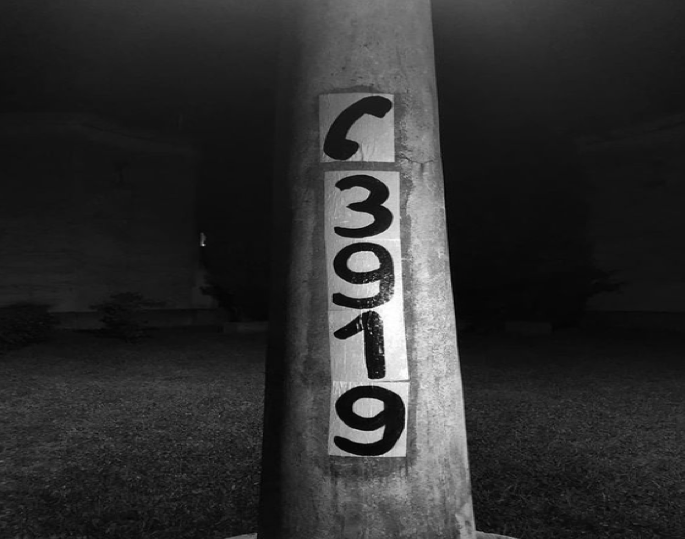
The post office queue is one example of such logic. The colleur·euses learn to read the city opportunistically, identifying opportunities for outreach created by the urban environment. City squares, pedestrian areas or bridges known for their traffic become potential sites: some collectives even mapped their neighbourhoods by the slowness of their traffic lights. The longer the red light, the better the wall, as a driver stopped at a red light becomes a reader whether they intended to be or not.
Longevity is the strategic priority above all others: a collage seen by a hundred people over three days is worth more than one torn down in an hour. Collectives paste high up to maximise the collages’ livelihood — often above eye level, out of reach of pulling, passing hands, using the city as a ladder, climbing onto bins, standing on benches, sometimes using window frames and drainpipes as footholds. One participant compared it to parkour. Another went further: pasting, she said, was like her cat urinating to mark territory. A way of saying: I was here. This space is mine.
The French geographer Henri Lefebvre argued that cities are not neutral containers, but are produced, shaped by the interests of capital and the state, and experienced differently depending on who you are. Against this, he proposed the right to the city: not merely the right to inhabit space, but to participate in its production, to leave their mark on it, to treat it as what he called an oeuvre — a collective work, made and remade by the everyday actions of those who inhabit it.5 David Harvey extended Lefebvre’s argument: the right to the city is not an individual right but a collective one — the power to reshape urban life in accordance with collective needs. The colleur·euses, covering the walls at night, are a fairly literal enactment of that idea.6
In that respect, feminist collages belong to the lineage of graffiti crews that have operated across cities worldwide for decades, claiming space through paint and stencils.7 Yet, collages differ in their deliberate refusal of the artistic, and the imagery that comes with it, only asking to be read. The practice can be seen as a form of tactical or DIY urbanism: small-scale activities undertaken by local citizens to make their immediate surroundings more liveable.8 Pasting in local neighbourhoods was therefore often the most practical choice: participants mentally mapped the walls of their area, which surfaces held glue best, where collages survived longest, and where they had not survived at all.
Knowing the neighbourhood also meant losing less time and taking fewer risks, but the geography of pasting was never purely convenient: where a collage goes up is as political as what it says. Collages in left-leaning, creative or gentrifying neighbourhoods tended to last longer because the communities were more tolerant of them; in contrast, in wealthier, more conservative areas, slogans were removed faster, sometimes within hours. Bourgeois neighbourhoods almost exemplified hostile urbanism, a refusal to let certain words exist on certain streets.
When asked about the topic, Sammy explained why it was important to be thoughtful about where they pasted, and why.
“We try as much as possible to adapt the message to the places we paste in. The hard-hitting messages — the ones that land like a punch — we put them where everyone can see them. But it means making assumptions about who is conscious of what issues, in a way it’s like putting people in boxes. It’s an uncomfortable thing to do. But it’s also a sociological reality.”
When we approached the police headquarters in Bordeaux, I asked Jill whether she had ever been arrested. She said that earlier this year, her collective had heard that a senior police officer had ordered the expulsion of a refugee squat housing ninety children at four in the morning. The group had decided to paste on the building in outrage, and she was arrested, spending a night in police custody. Jill’s situation is rare: the colleur·euses follow strict protocols designed to avoid exactly this kind of encounter. Yet, pasting on a police headquarter, in direct opposition to a decision made inside it, comes with its own logic, and its own risks. When Jill was released the next morning at dawn, she thought about photographing the slogan as a souvenir, but the collage was already gone.
Most collectives avoid public buildings entirely, as the legal risks are too high. Camille, who pastes in Amiens, takes a different view.
“We paste on public buildings to raise awareness, and also because our taxes will pay for the clean up, at least the money is going somewhere useful.”
Her argument rested on a specific frustration: feminist groups have calculated that fighting gender-based violence requires €1 billion annually in state funding. The government never delivered, despite French President Emmanuel Macron pledging when he was elected in 2017 that women would be the defining cause of his presidency.9
Though pasting on a busy bridge reaches more people, pasting outside a courthouse says something the bridge cannot. Several participants saw pasting in the vicinity of judicial or state power as a way to directly address the institution. In spring 2021, Valérie Bacot went on trial in Chalon-sur-Saône for the murder of her husband, a man who had abused her for nearly two decades. The trial was held 500 kilometres away from Marseille, but the collective pasted around the courthouse anyway.
From one city to another, Bacot’s case stood for something larger than one woman’s story: the failure of the French state to protect the abused. The collective pasted a primer beneath the slogan to provide background on Bacot’s story, explaining that while she had killed her abuser, it’s usually the other way around. Four years later, when Dominique Pélicot and 49 other men were tried in Avignon for the rape and sexual assault of his former wife Gisèle, collectives pasted messages of support to victims of sexual violence around that courthouse too.10
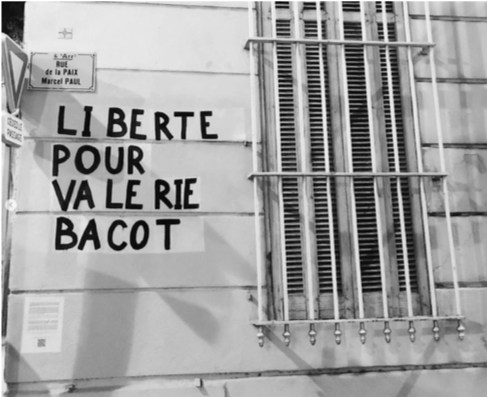
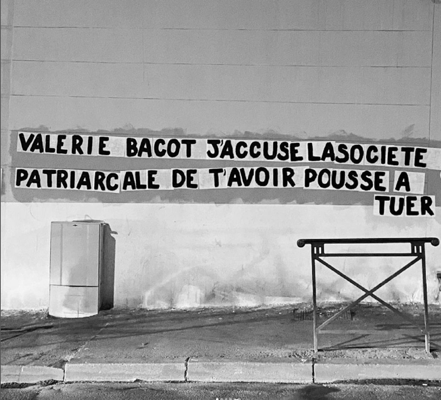
Figures 3 and 4: Left: Freedom for Valérie Bacot; Right: Valérie Bacot, I accuse the patriarchy of having made you kill, @Collages_Féminicides_Marseille
Visibility and safety pull in opposite directions, as the most watched spaces — city squares, main streets, train stations — are also the most surveilled. Collages are prohibited by law under Article 322-1 of the French penal code, which punishes the act of slight degradation to the built urban environment that results from ‘wilful damage’ with a €60 fine or community service. The colleur·euses operate under constant threat of arrest or fines as the practice remains a grey area, not quite legal. That said, unlike graffiti, sheets of paper can be removed without lasting damage, with general agreement among participants that being caught pasting would not result in a criminal record.
Most participants described scanning for cameras before pasting, protecting their anonymity by wearing dark clothes, hoods up, and faces covered. In cities with left-leaning municipalities, CCTV was sometimes sparse or even absent. In others, entire squares or busy streets riddled with cameras effectively rendered entire areas of the city off-limits.
Miriam expressed her frustration at the city council’s position in Amiens:
“The city council added cameras for what they call safety but we see it as a witch hunt against degradation. It’s against us really, if a woman would get assaulted in the street, the cameras would be useless as the footage would be deleted within 48 hours. It’s really just a way to reassure voters.”
Some city councils invest in anti-graffiti paint to deter exactly this kind of action, though some collectives jokingly told me that they had since learnt that glue perfectly adheres to these surfaces. Some participants see themselves as inadvertently forcing councils to maintain and refresh public infrastructure. A collage can disappear overnight, and the wall behind it be repainted by morning. In this way, the illegal act produces a civic good.
All in all, collages rarely last. In left-wing councils, collages are more widely accepted, sometimes seen as a continuation of street art. Miriam pointed at a slogan that had been on the wall for over a year, “LOVE IS LOVE”, written in bright, colourful letters.
“We pasted that slogan for Pride. It has stayed, people must think it’s street art, that’s why.”
Right-wing councils remove collages efficiently and cleanly, most of the time, in accordance with the ‘broken windows’ theory: the idea that visible signs of disorder, left unaddressed, invite further disorder. Participants could tell who destroyed a collage by how it was destroyed: a perfect removal was the council, everything else was a passer-by, whose reactions were sometimes radical.
On the lookout, Betty once noticed a man observing the group at work intently. Before she knew it, he moved closer:
“He started shouting at the group, kicking the bucket of glue over, before starting to rip the wet sheets of paper from the wall. We stayed calm but he was shouting, saying we shouldn’t do this.”
Not all responses to collages are physical. Residents tend to be less methodical than the council, using keys, or whatever is at hand, to remove specific letters or words, sometimes quietly inverting the meaning of a slogan. The collectives saw this as double violence: the form itself turned against its own message. Participants often avoided messages that could be easily inverted through the removal of a negative form, or a specific word (MY BODY IS NOT YOURS / MY BODY IS YOURS).
Others developed strategies to make removal harder. Dania described one used in Marseille: after pasting, members would run their keys across the sheets in a grid of slash marks, essentially pre-cutting the letters. When someone tries to rip the collage, it tears into fragments rather than coming away cleanly.
The collectives would return to repair the wounded slogans, pasting missing letters, repainting over partially ripped fragments. When walking in the 13th arrondissement of Paris, Miriam and I came across a slogan “SORORITÉ”, whose last E had clearly been repaired, as the paint was fresher than the other letters.
“It looks like someone else took over”, she commented.
Sometimes the dialogue went further than repair. Crossing a park, Miriam described what had happened to one of their slogans the previous week.
“We had pasted ‘SI ELLE EST SAOULE C’EST UN VIOL’ (if she’s drunk it’s rape). The next morning, I ran loops around the same park and saw that someone had ripped the ‘VIOL’ (rape) off, it was clearly that word that people didn’t like. When I ran again the following day, someone had written with a marker a ‘NON’ (no). The slogan went from ‘SI ELLE EST SAOULE C’EST UN VIOL’, to ‘SI ELLE EST SAOULE C’EST’, to ‘SI ELLE EST SAOULE C’EST UN NON’ (if she’s drunk it’s no).”
The wall had answered back.
Making space at night: reclaiming the nocturnal city
Before we turned the corner, Vicki warned me. We were approaching what she called ‘a very masculine space’ — a square in La Porte d’Arras, in Lille, with benches around its centre, each one occupied by men. A single path cut across the middle, and it was true that we were the only women there. Vicki said she rarely walked across: more often than not, she took the long route around, a detour that she was so used to taking that she had almost stopped noticing it. At night, she came here to paste, to leave something on the walls that said this square belonged to everyone.
Lefebvre’s right to the city has a problem: it assumes a city that is equally available to everyone. Judith Butler argued that the very concept of ‘the public’ as conceptualised by Lefebvre is a fiction: rather than a neutral space accessible to all, the public is a contested one, shaped by those who are made to feel that they belong, and those who do not.11 Vicki taking the long route around the square rather than walking across it exemplifies Butler’s argument, and was not unusual. Participants often described a city that changed character after dark: in some towns, after a certain hour, it was almost only men who were out. Pasting at night was a refusal of that inequality: a way of claiming back space that had, by convention and by fear, been quietly ceded because space was not experienced equally by everyone. Feminist geographers have shown that the city is gendered, racialised, classed — and that embodied identity shapes not just where you feel welcome but where you feel safe, how far you are willing to go alone, and at what hour.12
In Rouen, Kalel took me along a route her collective had followed before Pride, covering in slogans every street the march would pass through the following morning. Hours before the crowd arrived, they pasted messages of support to LGBTQ+ communities across the city in the dark, making the space safe for those who would walk the next day. As the group moved through the sleeping city, they thought about who would walk those same streets in daylight, and what they might need to feel less alone.
Night-time has always carried a charge. The cultural geographer Tim Edensor describes how long before the expansion of public artificial lighting, darkness was understood as a time of transgression, clandestine activity and deviance — a space that the Church and the State sought to restrict through curfews and night-watches, precisely because it offered freedoms daylight did not.13 Artificial lighting changed the city’s surface without changing its grammar: the night remains, as Sharpe writes, a second city — with its own geography, its own citizens, and its own rules about who belongs.14 The nocturnal city has a particular history in France. Paris has been the site of revolts in 1789, 1830, 1848, and 1968 — a geography of protest written in darkness as much as daylight. Most recently, the Nuit Debout movement — ‘Up All Night’ — gathered night after night on the Place de la République in Paris to protest the El Khomri labour reforms and the state of emergency imposed after the 2015 terrorist attacks, at a moment when public assembly had been restricted for security reasons.15
However, the freedom the night offers is not equally available to all. Andrea Dworkin argued that night is, for women, not a space of liberation but of danger — a time that belongs to men and promises harm to those who forget it.16 This very argument has been contested in practice for decades: the Take Back the Night marches, which began in the 1970s, were built on the refusal to accept the night as male territory. Yet, fear of sexual violence continues to structure women and gender minorities’ experience of public space. The geographer Gill Valentine showed how this works in practice: women develop what Valentine called geographies of fear — mental maps of the city that are constantly revised in response to who is present, what a street looks like, what time it is.17
Participants described their relationships to darkness as ambivalent — concealment and liberation in the same hour. What struck many of them on their first pasting sessions was how few women and gender minorities were out. Tina put it plainly:
“It’s a way to take back the street, as it’s not a space we usually strut around in. When I paste in the morning before going to work, I feel so badass. Being in a group, even if you don’t quite admit it to yourself, that helps. The night will always be scary for me. But it’s also a space where I can feel strong, so I’m going to try to remember that feeling.”
For many, that feeling took time to arrive. The night did not become safe, but rather became theirs. Lili was more direct: it felt good, she said, to be in a space that tends to be forbidden to you. Leta described what the group made possible:
“When we’re together, I don’t think about changing pavement if there’s a man approaching. On my own, I wouldn’t go into an alley I paste in with the girls.”
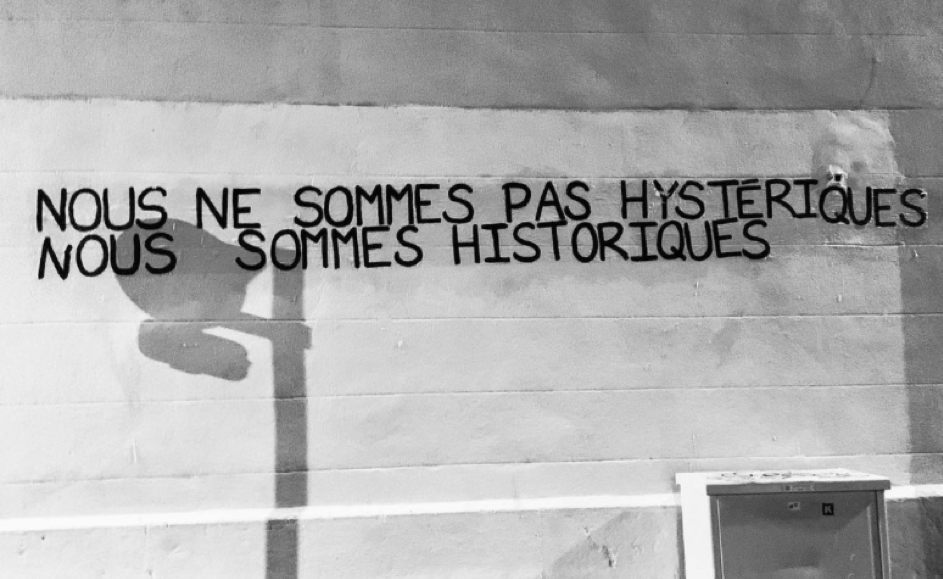
Many participants noticed they had become less apologetic in the street. Felicia told me a personal experiment she’d started:
“I’ve stopped moving aside on a pavement to let people pass by. Men ended up bumping into me and bang into my shoulder, but pasting really made me realise how I spend my time making myself small, and slaloming between people.”
Sammy had a particular vantage point, as a trans man.
“Now that I pass as a man, I’ve noticed that men move in the street to let me pass on a pavement, though when I passed as a woman, I used to get shoulder-barged constantly. I’ve become aware of the space I take up. Now I’m the one who moves aside for women.”
This change also showed up on the commute. Lili described how she used to walk to and from the train station — music in, hurrying down the road. She shared how she has tried to make a conscious effort to observe her surroundings since she started pasting: to claim the time back, but also to remind herself that she too has the right to linger in public places. Alice noticed a physical shift: on the métro, she now takes up space, whereas before she would make herself small. She mentioned in passing that she now confronts men she sees manspreading: “Don’t you see that this girl has no space?” Hélène has started to intervene on the RER when she sees a girl being pestered. She said that even though she was alone at the time, she felt supported by the group, as if the collective were present even when it wasn’t.
Participants also described the excitement and adrenaline brought by the practice. Anna tied the feeling to its forbidden nature:
“I like the fact that it’s illegal. I like to defy the rules. Overall, it feels good.”
Cathy located the feeling in the collective itself:
“The more we are, the stronger we are. When we’re together, we’re not afraid of anything — we’re like wonder women.”
The pleasure rested not only in the defying act, but also in the action being carried out in a group. Kalel described the very nature of the group as exclusive of cis men as something that was galvanising and empowering. Kati credits a sense of improved boldness and confidence to the practice:
“Now I realise when I walk in the street, I’m always the one shifting to let people pass, so now I try to walk straight ahead.”
The practice also changed how well participants know their cities. Born and bred in Paris, Hortense had always considered herself a true Parisian, but said that pasting has given her a different appreciation for her city learnt at night, on foot, down streets she had never had a reason to walk down before. Jo, who sits on the city council of her town on the outskirts of Paris, said that the knowledge she accumulated on pasting sessions made her a better representative.
“There are a lot of neighbourhoods I wasn’t used to going to. The practice allowed me to come to terms with the reality of areas I didn’t know. I used that knowledge to argue that certain places in the town weren’t safe or accessible for women. One suggestion I made was to build more playgrounds, to give women, who tend to look after children, a space they could claim. In my town, there are a lot of benches. And on benches, it’s often men who sit and linger.”
Femmage: collages as ephemeral monuments
Place des Quinconces in Bordeaux. Very early one morning in 2021, on one of the largest squares in France, ten women began to paste. On the four sides of the Monument des Girondins, a tall column rising out of cascading fountains, they covered the stone with a hundred names. The hundred victims of femicide in France in 2020.
“We were encouraged to do this by the families of the three victims of femicides in 2020 in the area”, Ali told me, as we stood in that same square a couple of months later. “It took months to organise. There were ten of us pasting, twenty to thirty people on the lookout.”
She paused. “I think that we all cried.”
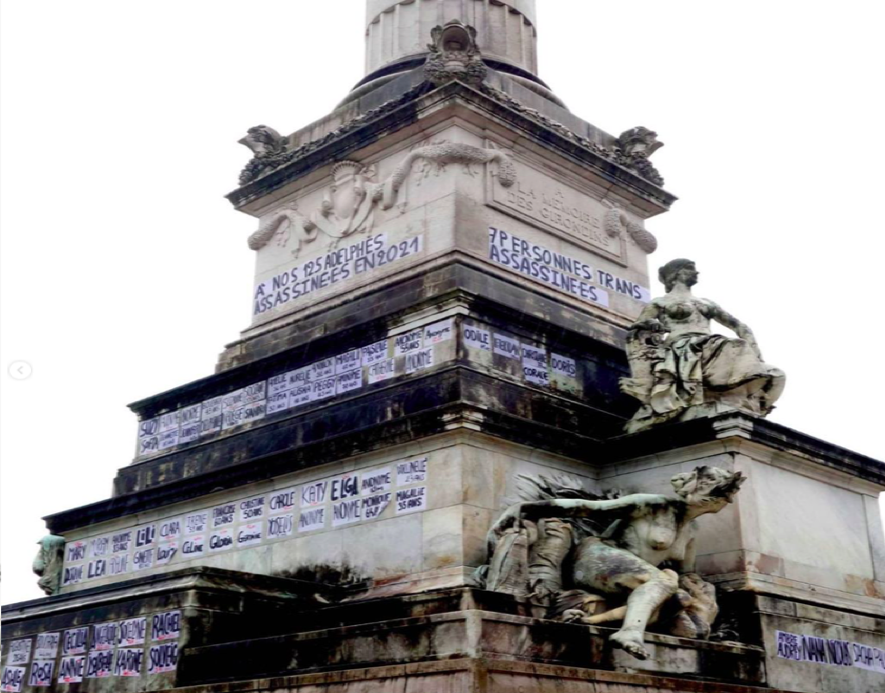
In French, a memorial is called an hommage, a word associated with homme — man. A deliberate rewriting of the word to focus on femme — woman in French, a femmage is a specific kind of pasting session. Femmages — like the one Ali described — are sessions organised with the informed consent of victims’ families, featuring the victim’s name, age and sometimes cause of death, reminding passers-by that behind the statistic, there was someone’s life.
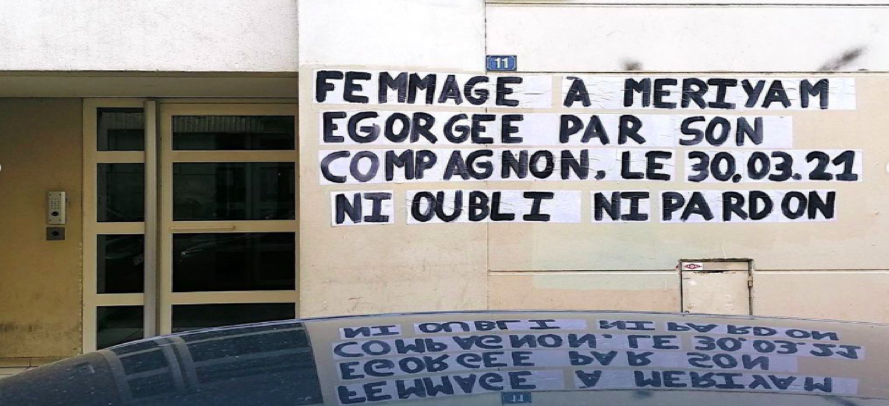
The historian Pierre Nora argued that collective memory ‘crystallises’ in sites — memorials, monuments, street names — built to preserve what societies fear forgetting.18 When the state honours in stone and bronze, femmage remembers in paper, and challenges the notion that the city should decide whose name survives. A study by Mapping Diversity, examining over 155,000 streets across 32 major European cities, found that 90% of streets named after individuals honoured white men.19 France does relatively better, but not by much: research by the newspaper Ouest France found that in 2025, just 13.3% of French streets were named after women, up from 9.5% in 1987.20 Even that figure is unreliable: the database the statistic is drawn from is populated by French mayors themselves, and a quarter of towns never filled in the form. Other studies have shown that when streets are named after women, they tend to be smaller, shorter and less frequented side streets rather than boulevards.21 Paris has tried to address this imbalance: between 2020 and 2026, the city renamed 57 streets, 30 parks and 47 commemorative plaques to honour women — among them Virginia Woolf and Mahsa Amini. Despite this, only 15% of the city bears a woman’s name.22
Collages participate in the creation of collective feminist memory, honouring the death of victims of femicide whose deaths the state has failed to prevent and often fails to name. Nous Toutes, whose methodology extends beyond intimate partner violence, reported that 170 women died of femicide in 2025.23 Femmages honour victims and make the state’s systemic failure visible.
Though the femmage brought tears to the collective’s eyes, others saw it differently.
“Our femmage was destroyed a couple of weeks after by Action Française, a French royalist and far-right group. They sent us pictures of themselves ripping down our work and posing with their flag in front of our memorial. They also placed Action Française stickers to show that it was them. It breaks our hearts because we don’t understand how anyone could possibly be against femicides, but we will commemorate again next year.”
The Bordeaux collective wasn’t the only one to report being targeted by far-right groups. Françoise told me about an interaction her collective in Angers had with Alvarium, a far-right group that had since been dissolved by ministerial decree in 2021 for racist behaviour.24
“Some members of the collective were pasting in the streets where Alvarium’s headquarters are. Some guys saw them and ran after them, one even pulled a knife.”
Women were a threat, too. Participants were unequivocal about Nemesis, a far-right TERF organisation that has adopted the collage form to spread racist narratives about sexual violence despite evidence showing that in 91% of cases of sexual violence, women knew their perpetrators.25 In most cases, these men are not violent psychopaths lurking in dark alleys, but well-known partners, friends, brothers, colleagues or mentors.
Tina described a collage her collective had pasted along Angers’ ring road — a statistic from Nous Toutes stating that fewer than 10% of all rapes result in a conviction.26 Despite its inaccessible location, it was torn down the next day.
“We’d pasted that message on an access to the ring road, in a bend, without a pavement. It was hard for us to paste there. The person who took it down must have actually gotten out of their car. I don’t understand why people do that”, she said. “It’s just a statistic. It’s a way to bring awareness. To question the judicial system.” Then she paused. “The person who did it must have felt targeted.”
As we walked through Marseille together, Dania and I came across many remnants — strips and corners of paper still stuck to walls, the words mostly gone.
“When I see bits of collages like this”, she said, touching the last of the bits of paper on the wall, “it’s almost as if they were scars.”
The private made political
What belongs in public and what belongs in private are not neutral questions. For the colleur·euses, it is a central one. Many participants described the practice as a way of making the private political, dragging into the open what the city and its culture had agreed to keep quiet.
Rita put it simply: collages were a way to speak about violent topics through rapid, visible means, breaking down silences and secrets.
When I conducted this research in 2021, incest and child sexual abuse were at the centre of French public debate. The publication of Vanessa Springora’s Le Consentement and Camille Kouchner’s La Familia Grande had broken a long silence, outing abusers who had been protected for decades by social convention and institutional indifference.27 Zoé described how her collective began to paste statistics and helpline numbers close to schools to start conversations. Statistics such as La Ciivise’s “out of a class of 30, 3 children are victims of incest”, were favoured by collectives.28
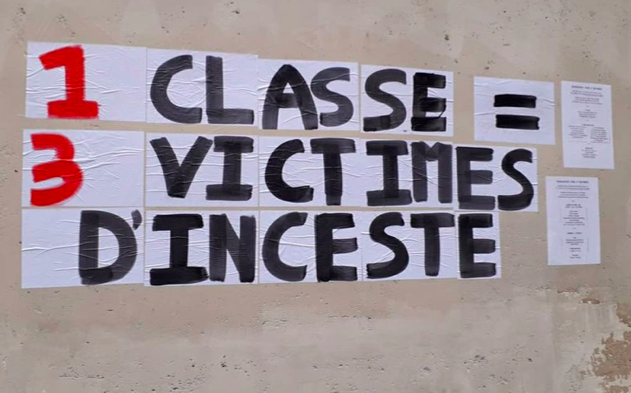
Zina made a broader observation about the movement’s cultural impact:
“I think collages participated in breaking that taboo, making political things we used to consider to be anecdotal.”
However, there was debate amongst the collectives on whether or not these messages were appropriate, as Miriam described:
“Some people didn’t want to paste messages related to violent issues close to primary schools, to not shock the children. I thought it would be great to paste on domestic violence, especially since schools could be one of the only places where women who are victims might be allowed to go. But it’s part of being part of a group, you have to compromise.”
Zoé was unequivocal about pasting near schools.
“Some slogans are hard — the topics are tough, incest especially. But it’s so important. The children can ask their parents questions, and the parents will be able to explain. I like to paste ‘Dad — it is forbidden to rape’, written in cursive. The sentence is strong. I hope that it acts as food for thought next to a school. Children walk in the streets too.”
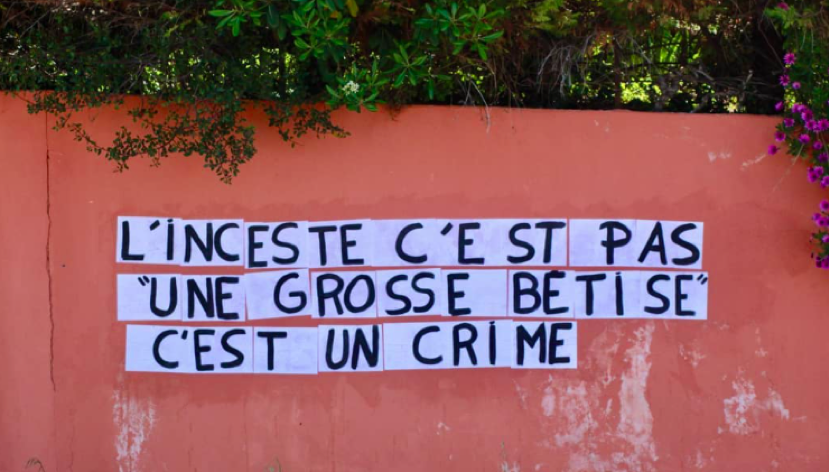
Françoise once witnessed such an interaction.
“We pasted a slogan that featured the word ‘PATRIARCAT’ by a pedestrian crossing. I saw a little boy ask his mum: ‘what does PATRIARCAT mean?’ And the mum stood and explained to the child what it was, even though the light had turned green.”
Some collectives like to bring theoretical concepts to the streets: single words, written large, with a small definition stuck below. Adelphité, for example, is a neologism in inclusive French that replaces the gendered ‘sororité’ (sisterhood) and ‘fraternité’ (brotherhood) with a word that belongs to neither — a term for the bond between siblings that does not assume their gender. Transidentité was another. Pasted on a wall at eye level, with a definition beneath, these words became something between a glossary and a provocation, making militant vocabulary visible and accessible to all. In this sense, both gestures were acts of translation, carrying knowledge from the spaces where it is held to the streets where it might be needed.
There was debate among the collectives about whether they belonged there at all. Zoé was in favour.
“Every time we paste these words, we always follow with a small definition stuck below to explain what it means. People who don’t know the word stop and read it. That’s the point.”
Others were less sure, feeling that these words circulated in activist spaces and university seminars and did not belong to the street. Pasting them on a wall risked alienating the people the movement most needed to reach.
Sammy felt that bringing awareness to these concepts was important.
“Pasting is also putting words on things that people don’t even realise exist: if it’s on a wall, it must exist somewhere. People might look it up. We can’t control how the message lands. But at least by putting it there, we know it’s something that is present.”
Zoé was 61 at the time and the oldest member of the Marseille collective. She said it was important for her to bring awareness to ageism, and share her own experience.
“We pasted ‘TU ES BELLE POUR TON ÂGE N’EST PAS UN COMPLIMENT’ (you are pretty for your age is not a compliment). After menopause, women disappear from the social landscape. This slogan is important, it implies that if you look your age, you’re ugly.”
She told me about another message the group had pasted.
“J’AI 60 ANS ET JE VEUX FAIRE L’AMOUR” (I’m 60 and I want to make love), close to a care home, when another woman stopped by and said “what about me, I’m 70”.
Zoé reflected on the lesson here.
“Of course, I wrote this because I’m 60, but people older should also be included. It was very moving.”
The walls hold grief and irreverence in equal measure. Other slogans were more light-hearted. Several collectives independently landed on the same pun, “Patriarcat-caca”, pasted on public toilets. The pun collapses ‘patriarcat’ — patriarchy — into ‘caca’, the French child’s word for excrement.
Collages also break silence. Ali spoke: “Before I struggled to speak out. Now I tell myself, if I’m able to say what I think on a wall for the whole city to see, why should I find it difficult.”
Some were able to reflect on their own experiences, with one participant sharing:
“I was raped in 2017. On the municipal electoral list, I found my rapist’s name. I didn’t want any publicity. One day I went out and saw a collage that said ‘JE TE CROIS’ (I believe you). I burst into tears. I received, freely, love and kindness, words you simply never hear.”
Some, such as Prune, were able to take action.
“Pasting has helped me put words on the violences I’ve been subject to. I’ve been able to go to formally report the violence to the police and speak about it with my daughter.”
With less than 10% of rapes in France recognised by the courts, the wall offers something the justice system cannot. Charlotte put it plainly: “Pasting victims’ testimonies is also a way of giving them a form of recognition that the justice system cannot provide.”
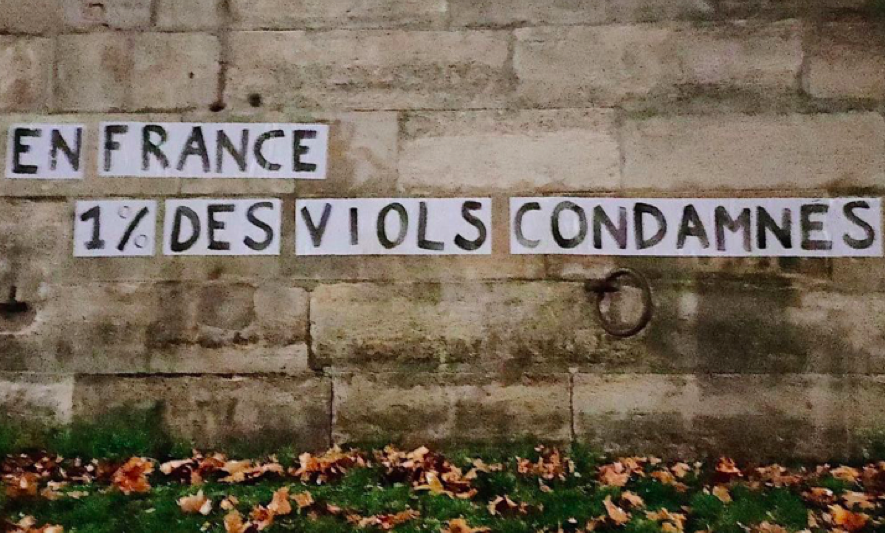
Some collectives became support networks themselves. Charlotte said a minor contacted her collective on Instagram saying that she was a 13-year-old victim of prostitution, and was seeking help to get out.
“We pasted her testimony, and two young men saw us and came to see us to tell us that they knew someone who was being trafficked in their cité nearby. We were able to formally alert the local social services, and it was a way for us to say that we were there.”
Back in 2021, I ended my dissertation on an acknowledgement that my failure to include more transgender experiences has implicitly centered my work around reclaiming the urban experience of cisgender women, and that conducting ethnography and participant-observation by accompanying participants during collage sessions would have permitted me to better explore the importance of different subjectivities in producing varied experiences of urban space. Almost five years later, though I have since then participated in sessions myself, my initial findings still stand.
At the time, when I asked participants how they had come to join the movement, many said the same thing: it was accessible. Anyone could do it. No years of feminist theory required, no particular skills.
Alex put it directly: “You don’t need to have studied for ten years, or been a feminist for years to paste. It’s simple and open to everyone.”
What became clear over the course of my research, was that this was not quite true. Sessions are prepared over several days: from choosing and voting on slogans, to painting them letter by letter, waiting for the paint to dry, then going out at night to paste. Pasting also requires supplies — acrylic paint, A4 paper, glue, brushes, and being capable of walking and carrying equipment for hours in the dark. While the practice presents itself as open, I can confirm from experience that the conditions it demands are not.
Ninon put it bluntly.
“Pasting isn’t for everyone for a lot of reasons: people who are disabled, who don’t have ‘papiers’, and cannot take the risk to be arrested by the police. But everyone can prepare slogans that can be pasted by people who have the time, the energy and the possibility to do so. It’s not just paint and paper.”
In 2021, I did not recognise the inherent ableism of my research protocol until a participant who had expressed interest turned me down because of a recent injury, and I realised, too late, what I built into my methodology without meaning to.
Charlotte lives with chronic pain that affects her mobility. Traditional forms of activism, such as protesting or pasting sessions — the night-time walking and the hours on your feet — were not designed for her. When the 2020 curfew and lockdown made pasting at night impossible, Charlotte and her collective across the Val d’Oise (95) found a workaround: the panneaux d’affichage libres, the designated public display boards that line French streets, usually carrying local advertisements, or notices for lost cats. The collective could paste in daylight, legally, without carrying anything far. When the curfew lifted, they kept going.
“We can paste in broad daylight, and those who couldn’t paste because of child-minding responsibilities, financial reasons, or their jobs, now can.”
Charlotte described how her collective built a database mapping all of the panneaux d’affichage libres in the 95. However, even this method has its own limits: some boards are covered by lockable glass, requiring the collective to write to the city council to access a surface that is supposed to be freely available. Other collectives were frustrated at the small surface for expression allowed by the panneaux d’affichage libre. As we walked past a board in Ivry sur Seine, Zina commented, unprompted.
“I think the political reach is limited, we don’t have the same freedom. It’s a way for the state to say yes you can express yourselves but just there — you only have four metres by two.”
Other participants adapted the dominant practice. Marine mentioned that one member with a sore back had decided to print the A4 sheets of paper rather than spending an hour crouching down on the floor to paint them. She added: “It’s still quite rare. You need access to a printer. And when you do, it’s expensive.”
The collectives describe themselves as intersectional feminists but the composition of the groups often tells a different story. Betty pastes in Bordeaux. Originally from la Réunion, she had been part of a collective there before moving to la métropole — mainland France, and was struck, on arrival, by the lack of diversity in her new collective. This was apparent across every collective I encountered, and something I have personally experienced myself in my own activism. Participants were frank about why.
Jenna said it wasn’t surprising.
“When you think about who feels legitimate to claim public space, and who can actually take the risk — we know that when you’re not white, you don’t perceive the police in the same way. You tend to be more afraid of them.”
Julie was equally direct: “It’s really easy for us, as white women, to protest. We’re not victims of police brutality. We’re not putting ourselves in danger by doing so.”
Interactions with the police varied by collectives. Some reported peaceful interactions. In Bordeaux, Betty recounted a time when pasting in a deprived neighbourhood, the police stopped by.
“They just told us to be careful, because there had been a riot between two gangs, and that it was dangerous, that we shouldn’t really stay there. They asked if we were part of a group. We said no we’re friends, they wished us good night and drove off. We were a bit worried but that was the end of our interaction.”
Others were lucid towards their relationships to the police.
Annika said: “If we were black men, then yes, the police would be a threat, but we’re often privileged white women, so we can get a fine, the worst would be to be held in custody. We’re nice little white girls, the worst they can do to us is to ask us to take off what we’ve just pasted.”
Lili was more direct about what the practice revealed. “I think about the people who work for the city council, and who spend their time cleaning up after us. It mustn’t be easy for them, in fact, it’s actually social domination — it’s often people of colour who work in maintaining urban spaces. We just give them more, pointless work.”
Participants were self-critical in ways that were striking. Some collectives had stopped pasting on racial issues altogether, aware that their lack of diversity made them the wrong messengers.
Una mentioned: “Collectives are often diverse in terms of sexual orientation but for the most part, we tend to be educated and privileged, with little people of colour. It’s not really surprising — when you think who feels legitimate to claim urban space, what relationship some have with the police, and who sees risk and dangers in different ways.”
Some tried to avoid what they called white saviour syndrome — pasting on topics too remote from their own experience. Others took a different position: precisely because they were white, cisgender, able-bodied with the time and resources to dedicate to activism — and with the relative safety to risk arrest — they felt an obligation to use that position, and speak on behalf of those who couldn’t afford to.
Sammy reflected on the question. “I can say what I want on the street’s wall, I can say things that people need to say but can’t say.”
“When we are just between white people, we don’t paste on topics on racism, we think it’s not our job. Pasting gives you the ability to say things on a city wall that other people need said but cannot say themselves — and that this is a position of power as much as solidarity. But there’s also a wider question about people who can’t paste for various reasons and that maybe it’s our job to do that but we don’t want to appropriate their voices. I think it’s important to be self critical and say that we’re not omniscient, a living God on earth of inclusive feminism and all, of the other struggles that exist, so taking a step back and closing my fucking gob is also important.”
In 2026, the movement is as dynamic as ever, continuing to grow and change in ways this research could not fully account for. I now live in London and smile to myself every time I see a slogan along Regent’s Canal.
In Sammy’s words:
“The street belongs to me as much as it belongs to you. And until you understand that, I’ll keep pasting on walls — telling you, very kindly, to go fuck yourself.”
A big thank you to everyone who took the time to speak to me in September 2021, without whom this project would not have been possible.
Notes
- Collages Féminicides Paris (2021). Notre colère sur vos murs, Éditions Denoël. ↩
- Crenshaw, K. (1991). Mapping the Margins: Intersectionality, Identity Politics, and Violence against Women of Color. Stanford Law Review, 43(6), pp. 1241–1299. ↩
- Bard, C. (2020). Féminismes — 150 ans d’idées reçues, Le Cavalier Bleu. ↩
- Ministère chargé de l’égalité femmes-hommes (2020). Les violences conjugales pendant le confinement. Available at: egalite-femmes-hommes.gouv.fr ↩
- Lefebvre, H. (1991). The Production of Space, Oxford: Blackwell. ↩
- Harvey, D. (2003). The right to the city. International Journal of Urban and Regional Research, 27(4), pp. 939–941. ↩
- Zieleniec, A. (2017). The right to write the city: Lefebvre and graffiti. Environnement Urbain, 10. doi.org/10.7202/1040597ar ↩
- Iveson, K. (2013). Cities within the City: Do-It-Yourself Urbanism and the Right to the City. International Journal of Urban and Regional Research, 37(3), pp. 941–956. ↩
- Ministère chargé de l’égalité femmes-hommes. L’égalité entre les femmes et les hommes déclarée grande cause nationale par le Président de la République. Available at: egalite-femmes-hommes.gouv.fr ↩
- France 24 (2024). Collages as a reminder: the dedicated women supporting Gisèle Pélicot. Available at: france24.com ↩
- Butler, J. (2011). Bodies in Alliance and the Politics of the Street. Available at: eipcp.net ↩
- Rose, G. (1993). Feminism and Geography: The Limits of Geographical Knowledge. Minneapolis: University of Minnesota Press. ↩
- Edensor, T. (2015). The gloomy city: Rethinking the relationship between light and dark. Urban Studies, 52, pp. 422–438. ↩
- Sharpe, W. C. (2008). New York Nocturne: The City after Dark in Literature, Painting and Photography, 1850–1950. Princeton, NJ: Princeton University Press. ↩
- Shaw, R. (2017). Pushed to the margins of the city: The urban night as a timespace of protest at Nuit Debout, Paris. Political Geography, 59, pp. 117–125. ↩
- Dworkin, A. (1993). Letters from a War Zone. New York: Lawrence Hill Books. ↩
- Valentine, G. (1989). The Geography of Women’s Fear. Area, 21(4), pp. 385–390. ↩
- Nora, P. et al. (1984). Les Lieux de mémoire, Paris: Gallimard. ↩
- Mapping Diversity / RICS. Women and street names. Available at: rics.org ↩
- Noms de rue, une lente féminisation en marche. Ouest-France. Available at: ouest-france.fr ↩
- Nantes Métropole. Nom de rues — place aux femmes. Available at: dialoguecitoyen.metropole.nantes.fr ↩
- Ville de Paris. Féminisons les noms des rues. Available at: paris.fr ↩
- NousToutes. Mur de femmages 2025. Available at: noustoutes.org ↩
- La dissolution du groupe d’ultra-droite d’Angers l’Alvarium confirmée par le Conseil d’État. Ouest-France. Available at: ouest-france.fr ↩
- Sénat (2023). Rapport sur la prévention de la récidive des auteurs de viol et agressions sexuelles. Available at: vie-publique.fr ↩
- Ibid. ↩
- Springora, V. (2020). Le Consentement, Paris: Grasset. Kouchner, C. (2021). La Familia Grande, Paris: Seuil. ↩
- CIIVISE (2024). Rapport d’étape. Available at: ciivise.fr ↩